Sustainable Supply Chain Management Framework
As a leading global electronic components manufacturer, we are committed to providing customers with the highest-value products and services. In addition to meeting customer requirements and integrating upstream and downstream supply chain resources, we actively incorporate Environmental (E), Social (S), and Governance (G) values into our operations. Through close collaboration with supply chain partners and continuous enhancement of internal supply chain management systems, we strive to build a sustainable supply chain.
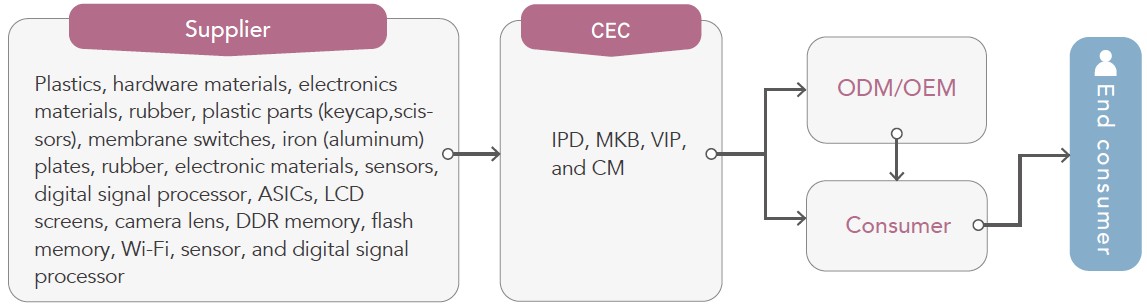
Chicony Value Chain
Organizational Structure
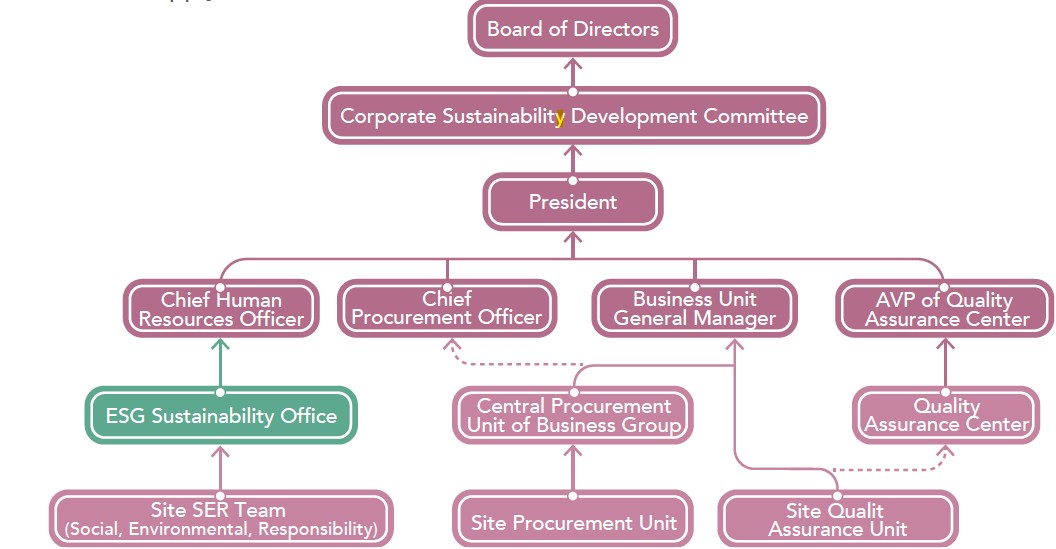
Chicony's Board of Directors serves as the top overseeing unit for sustainable supply chain promotion. Day-to-day operations are jointly managed by the Central Procurement Division of each Business Unit, the Quality Assurance Center, and the ESG
Sustainability Office, while implementation is carried out by site-level teams or task-based units (SER Teams) to collaboratively promote a sustainable supply chain. We report progress and performance annually to the Corporate Sustainable Development Committee and subsequently to the Board of Directors.
Sustainable Supply Chain Management
When receiving procurement requests from BU, if the supplier is an existing one, the Unified Purchasing Center of the Business Unit is responsible for supplier sourcing and procurement price negotiation. The BU’s procurement team then places the order with the supplier. For miscellaneous items, sourcing and price negotiation are handled directly by the individual factory. To mitigate the risk of material shortages or supply chain disruptions, each type of raw material is sourced from at least two
suppliers. We also prioritize long-term strategic partnerships with various suppliers to ensure stable and reliable relationships.
Supply Chain Management Process

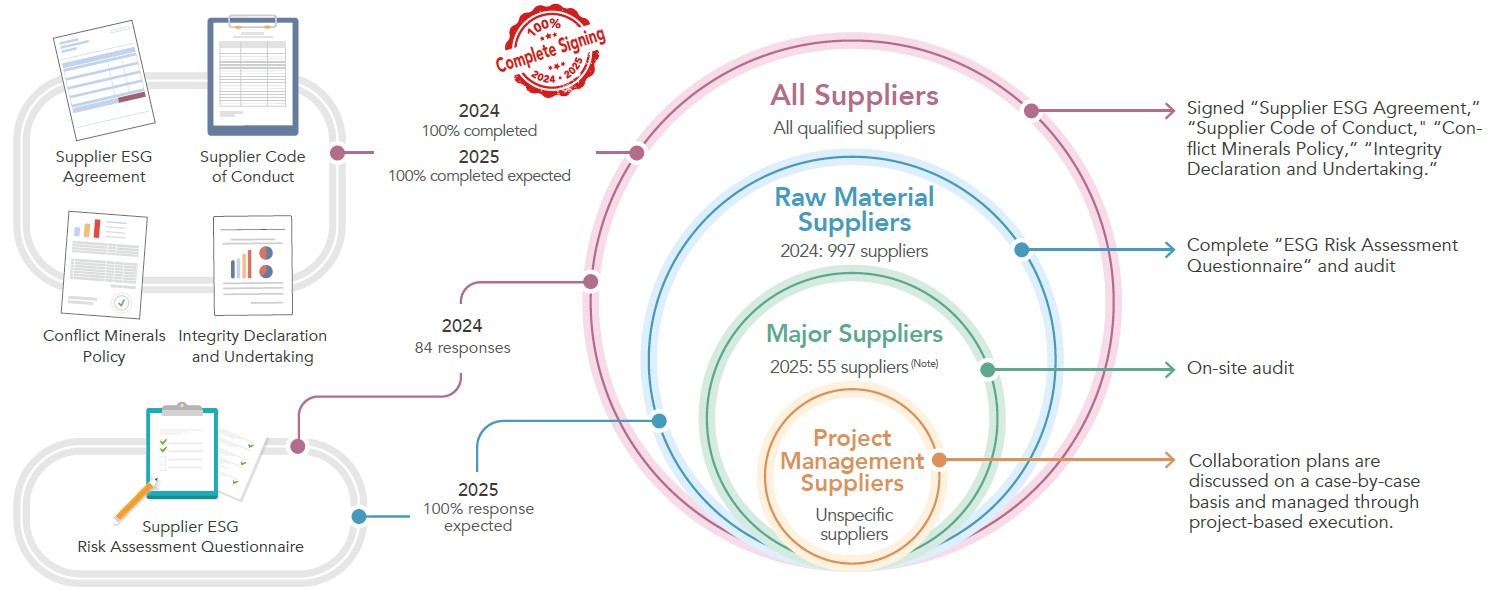
In the second half of 2024, to effectively promote sustainable supplier management, the ESG Sustainability Office integrated relevant documents from various units and factories, and updated existing documents including: “Chicony Electronics Corporation Supplier ESG Agreement,” “Chicony Electronics Corporation Supplier Code of Conduct,” “Chicony Electronics Corporation Conflict Minerals Policy,” “Chicony Electronics Corporation Integrity Declaration and Undertaking,” “Chicony
Electronics Corporation Human Rights Policy,” and “Chicony Electronics Corporation Supplier ESG Risk Assessment Questionnaire.” These documents will serve as the foundation for promoting sustainable supply chain management in 2025. The implementation status for 2024 and the measures to be promoted starting in 2025 are described as follows.
1. Supplier Document Management Requirements
(1) New Suppliers
When onboarding new suppliers, information such as company size and financial status is required. An integrity risk assessment is also conducted by reviewing public records and official government websites, covering operational status, risk profiles, legal disputes, and other relevant matters.
(A) Documents to be signed: “Chicony Electronics Corporation Supplier ESG Agreement,” “Chicony Electronics Corporation Supplier Code of Conduct,” “Chicony Electronics Corporation Conflict Minerals Policy,” “Chicony Electronics Corporation Integrity Declaration and Undertaking,” and “Chicony Electronics Corporation Supplier ESG Risk Assessment Questionnaire.” Starting in
2025, new suppliers will only be required to respond to the “Chicony Electronics Corporation Supplier ESG Risk Assessment Questionnaire” if they are raw material suppliers.
(B) In 2025, 100% of new suppliers are required to complete the signing and return of the aforementioned old version documents, with an actual achievement rate of 56%.
(2) Current Suppliers
The retention of current suppliers supports our continuous operations; however, associated supplier risks must also be carefully managed to minimize potential supply chain disruptions. To address this, we have implemented a four-tier supplier management approach.
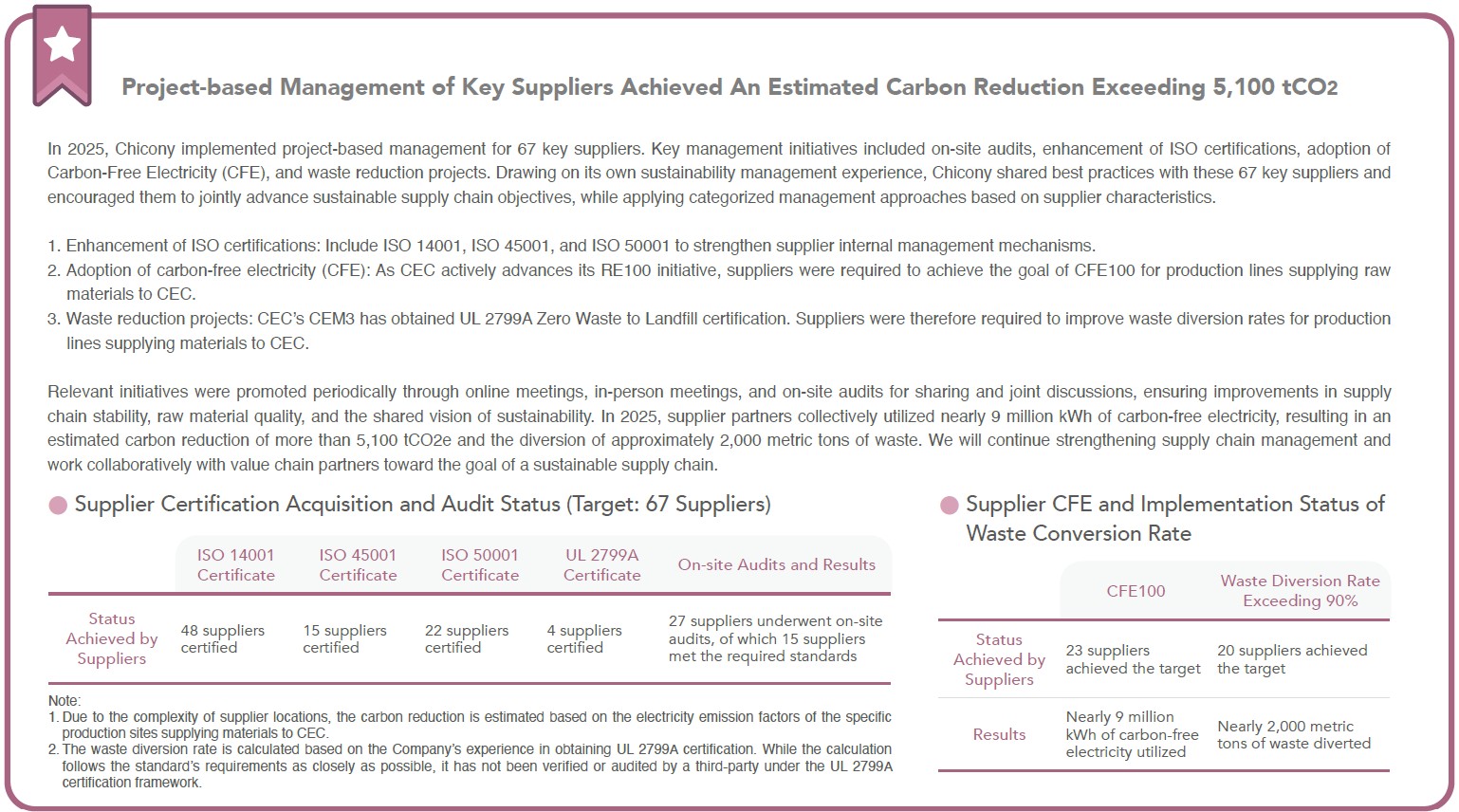
Project-based Management of Key Suppliers
2. Supplier Risk Assessment Mechanism
(2) Quality Assurance Center
Regarding quality, the Quality Assurance Center and the on-site Quality Assurance Unit will jointly conduct relevant evaluations, performing either written audits or on-site audits based on the circumstances of the raw material suppliers. On-site audit results are categorized into three rating tiers: 0–64, 65–79, and 80–100. Suppliers receiving the lowest tier (0–64) will be disqualified. For suppliers in the other two tiers, follow-up actions are taken on identified deficiencies to ensure compliance with the Company’s raw material quality standards. No supplier was cancelled in 2025, and all deficiency items were also tracked to completion.
If suppliers have any concerns regarding the routine management or audit results conducted by the Quality Assurance Unit, they may raise the issue with the designated factory personnel, the management department, or through the direct reporting mailbox.
2025 Quality Issues Audit Results
| BU A | BU B | BU C | BU D | ||
|---|---|---|---|---|---|
|
Number of Written Audits |
151 | 52 | 291 | 0 | |
| On-site Audit | 194 | 128 | 24 | 49 | |
| Overview of Major Deficiencies | Mostly due to insufficient on-site 5S management. | ||||
(3) ESG Sustainability Office
Chicony has established Social, Environment and Responsible Teams (SER Teams) at each factory. These teams were previously managed by the Human Resources Department at HQ. Since the establishment of the ESG Office in 2024, overall coordination has been transferred to the ESG Office.
he SER Teams assist each factory in managing supplier-related issues concerning RBA compliance, BCP planning, and customer requirements. They also conduct both documentation reviews and on-site audits of suppliers. Since 2022, to strengthen the basis for audits, suppliers have been required to complete the “Chicony Electronics Corporation Supplier ESG Questionnaire” to self-assess. Based on the results and with reference to the RBA process, on-site or remote audits are conducted to verify the current status of suppliers. If specifically requested by customers, third-party audits may also be arranged, thereby promoting sustainable transition throughout the supply chain.
2025 Audit Methodology
| Provide RBA Report | Written Audit | On-site Audit | |
|---|---|---|---|
| Number of Suppliers | 15 | 4 | 31 |
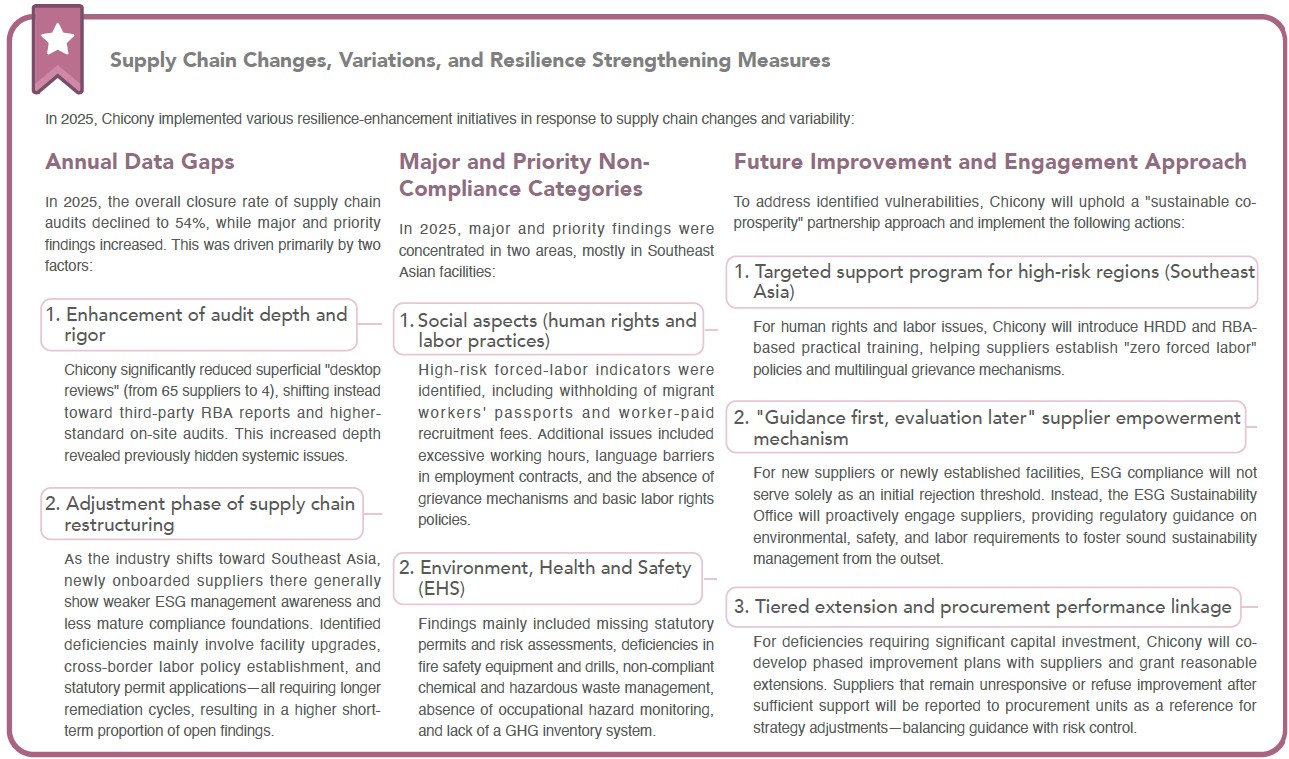
2025 Audit Results
| Significant Deficiencies | Major Deficiencies | Minor Deficiencies | ||||
|---|---|---|---|---|---|---|
| Deficiency Status | Closed | Unresolved | Closed | Unresolved | Closed | Unresolved |
| Missing Items | 19 | 34 | 232 | 219 | 73 | 26 |
| Case Closure Rate | 36% | 51% | 74% | |||
| Total Missing Items | 603 | |||||
| Total Case Closed Rate | 54% | |||||
| Overview of Major Deficiencies | Labor rights, occupational health protection, safety in the workplace environment, establishment of environmental management systems, and waste management. | |||||
Amendment of the Supplier ESG Risk Assessment Questionnaire
The “Chicony Electronics Corporation Supplier ESG Risk Assessment Questionnaire” was amended in the second half of 2024
and is applicable starting in 2025. In 2024, a social and environmental impact assessment was conducted in accordance with the
“Chicony Electronics Corporation Supplier ESG Questionnaire,” with no significant impacts identified for the suppliers.
| Old Version | New Version | |
|---|---|---|
| Applicable Year | 2022-2024 | After 2025 |
| Applicable Supplier Categories | New Suppliers | New Raw Material Supplier Current Raw Material Supplier |
| Survey Items |
Three Major Categories
|
Three Major Categories
|
| Key Discrepancies |
|
|
RBA Factory of Choice
Chicony Electronics has long been committed to sustainable governance and implementing corporate social responsibility at
the highest standards. In 2025, Chicony reached a significant sustainability milestone: All major production sites were 100%
successfully certified as Responsible Business Alliance Factory of Choice (RBA Factory of Choice, FOC), concretely demonstrating
our operational resilience in respecting human rights, labor rights, environmental sustainability, and business ethics.
Our responsible management system has undergone years of continuous enhancement. Since joining the Electronic Industry Citizenship Coalition (EICC) (the predecessor of the RBA) in 2011, we have consistently upheld our core values. To fully align with international standards, Chicony officially launched the RBA FOC certification initiative in 2021 and completed certification
for five major production sites in 2023. Building upon this successful experience, Chicony initiated a fullsite certification program at the end of 2024. Through systematic standards assessments and continuous improvement mechanisms, Chicony successfully fulfilled its commitment to achieving certification across all production sites in 2025. Going forward, we will continue
strengthening our ESG competitiveness and advancing our corporate vision of “responsible operations and shared value creation.”
Low-Carbon Supply Chain
To achieve Chicony’s short-term 2030 target set under the Science Based Targets initiative (SBTi) and our self-defined long-term 2050 carbon reduction goal, managing Scope 3 procurement emissions remains the most challenging task. In response, Chicony launched the “Chicony Green Octagon” project in 2023, within which the “Green Procurement” initiative focuses on reducing upstream raw material emissions. This initiative centers on three primary objectives: green procurement, local sourcing, and green suppliers.
1. Green Procurement
We have no relevant regulations regarding green procurement at our various factory locations. Therefore, in 2023, we referred to Taiwan's Green Procurement System for Private Enterprises and Organizations and required our procurement department to implement green procurement and conduct the initial inventory. In 2025, as certain production lines of various business units were gradually relocated to Thailand, Chicony became increasingly familiar with green procurement options available in the Thai market, resulting in a gradual recovery in both the overall amount and number of green procurement transactions.
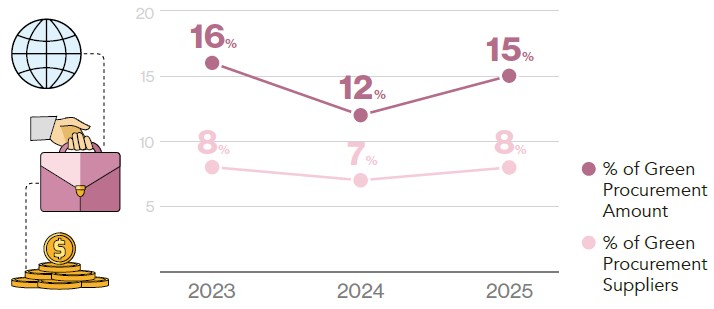
Contribution of Green Procurement Amount and Suppliers
Note:
1. Internal transfers were excluded when calculating the above percentages.
2. Definition of green procurement: The procurement of PCR, PIR materials / packaging materials, PIR materials, water - based paints, environmental - protection - related consultations, renting instead of buying, renewable energy, LED tube lights, bicycles (including electric bicycles), electric vehicles, and various eco-labels.
3. % of green procurement amount = Total green procurement amount ÷ Total procurement amount x 100%
4. % of green procurement suppliers = Number of green procurement suppliers ÷ Total number of suppliers x 100%
2. Local Procurement
To reduce carbon emissions from upstream transportation and relevant delivery costs, promote local development, and efficiently obtain after-sales service, we actively promote our local procurement policy by deploying most of our suppliers in factories’ neighboring areas.
Due to continuous product transformation and innovation in recent years, demand for our eSports series and multifunctional video/imaging products has been growing, and the use of precision electronic materials has been increasing year by year. However, the impact of the demand for AI and regional wars throughout the world has led to a shortage of metal components, resulting in constant price increases for electronic materials. Therefore, we will continue to search for partner suppliers to reduce relevant costs. In addition, as the relocation of production lines to Thailand was gradually completed across various business units in 2025, Chicony became more familiar with local suppliers and leveraged our collective procurement capabilities, resulting in declines in both the amount and number of local procurement transactions.
% of Local Procurement Amount and Suppliers
| % of Local Procurement Amount | % of Local Procurement Suppliers | |||||
|---|---|---|---|---|---|---|
| 2023 | 2024 | 2025 | 2023 | 2024 | 2025 | |
| BU A | 80% | 81% | 73% | 90% | 83% | 87% |
| BU B | 90% | 87% | 87% | 92% | 90% | 89% |
| BU C | 9% | 6% | 8% | 28% | 30% | 27% |
| BU D | 32% | 35% | 62% | 76% | 37% | 76% |
| Total | 58% | 49% | 54% | 72% | 61% | 69% |
Note:
1. Internal transfers were excluded when calculating the above percentages
2. Local: Taiwan for Taiwan, Mainland China for Mainland China, and Thailand for Thailand.
3. % of local procurement amount = Total local procurement amount ÷ Total procurement amount x 100%
4. % of local procurement suppliers = Number of local procurement suppliers ÷ Total number of suppliers x 100%
To achieve effective sustainable supply chain promotion, in the first stage, we focuses on its critical suppliers (please refer to 3.1.2 Sustainable Supply Chain Management for details) as the scope of promotion. Green supplier identification has been conducted, and we will encourage the selected suppliers to make continuous efforts in developing "green" (eco-friendly) products.
To this end, we continuously holds both in-person and virtual supplier conferences at its various factories to communicate our organizational vision, the Chicony Electronics Corporation Human Rights Policy (see Section 4.1.4 Chicony Electronics Corporation Human Rights Policy), and the CEC Whistleblowing Mailbox Policy, enabling suppliers to gain a deeper understanding of Chicony. During these conferences, supplier expectations are also clearly communicated, including the implementation of the Responsible Business Alliance Code of Conduct (RBA COC) and due diligence under the Responsible Minerals Initiative (RMI). These efforts aim to engage suppliers in supporting and addressing various sustainability issues, thereby advancing the shared vision of a sustainable supply chain. Two online supplier conferences were held in 2025, with a total supplier attendance rate of 85%.