"Biodiversity" not only reflects the richness of life on Earth but also maintains the balance of ecosystems, influencing key ecological services such as climate regulation, water resource cycling, soil fertility, agricultural production, and human health. In 2022, countries around the world reached a consensus at the 15th Conference of the Parties to the Convention on Biological Diversity (COP15) to provide goals and management guidance for global biodiversity policies and actions before 2030 through a new Global Biodiversity Framework (GBF).
Biodiversity Policies and Initiatives
A 2023 study indicated that humanity has already exceeded six planetary boundaries, including biodiversity loss. The Living Planet Report 2024, published by the World Wide Fund for Nature (WWF), further reported that global wildlife populations have declined by 73% since 1970.
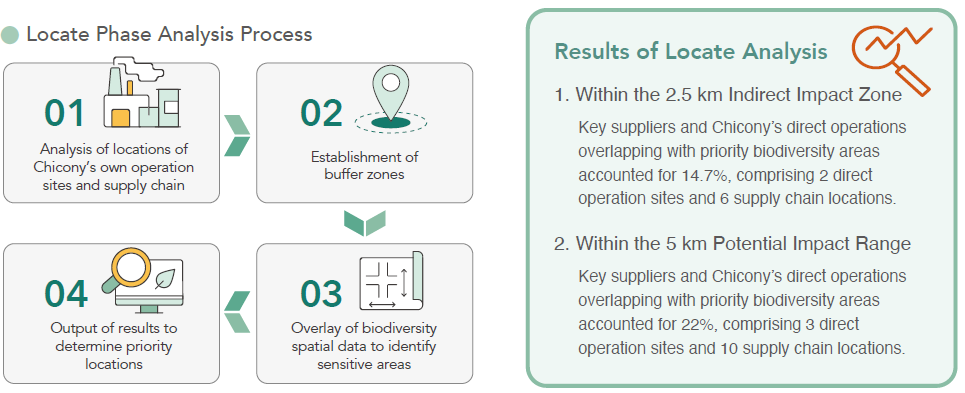
In alignment with the TNFD-recommended LEAP approach, Chicony conducts its analysis through a two-tier assessment framework. At the first level, we examine both our supply chain and owned operating sites, using location-based and industry-level ENCORE analysis to understand the natural sensitivity of surrounding environments, as well as the industry’s dependencies and impacts on nature. Based on this analysis, we identify priority locations among suppliers and owned sites. At the second level, we further refine industry-level dependencies and impacts to the site level. For these priority locations, we conduct localized operational activity analyses to assess the interactions between nature-sensitive sites and their surrounding environments. Through ongoing collaboration with upstream suppliers and key business partners, we aim to co-create a sustainable future, progressively achieving “No Net Loss” and advancing toward “Net Positive Impact.”
Management of Biodiversity Sensitive Areas and Significant Dependencies & Impacts in the Value Chain
Based on the TNFD LEAP approach released in September 2023, Chicony Electronics has assessed nature-related risks and opportunities. For details on the nature-related risk assessment, please refer to Section 2.2, “Climate- and Nature-related Financial Disclosures.” We recognize that the relationship between the state of natural capital and our business operations is closely linked to the “location” and “dependencies” of the subjects being analyzed. In addition, both our own operations and the upstream production of raw materials in the electronics industry may have potential impacts on ecosystems. For further information, please refer to CEC’s inaugural “Task Force on Climate-related & Nature-related Financial Disclosures Report.”
Locate Analysis
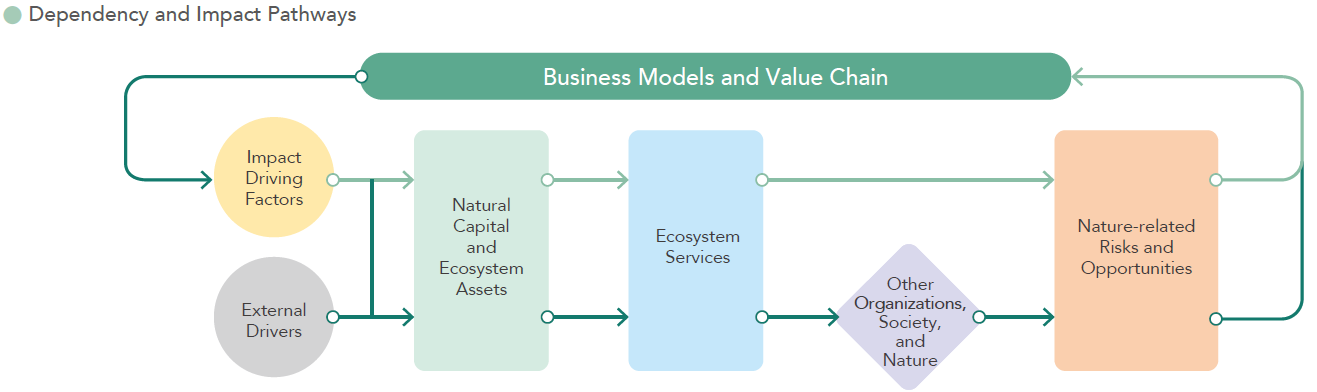
Building on the priority locations identified in the Locate phase, CEC conducted an “Evaluate” analysis to gain a deeper understanding of the dependencies and impacts associated with our operations and natural capital. By leveraging the ENCORE tool and incorporating procurement weighting factors for key suppliers, we applied an input–output model to systematically identify nature-related hotspots across our value chain. The results indicate that our operations exhibit a high degree of dependency on “water resources” and “air pollution dilution capacity.” Meanwhile, the primary impact drivers are concentrated in pollution generation, resource use, greenhouse gas emissions, and habitat disturbance.
To further strengthen the assessment, we integrated biome analysis and focused on the settlement and paddy-field ecosystems surrounding our operational sites. Drawing on the Natural Capital Protocol, we established comprehensive “dependency pathways” and “impact pathways” across four critical forms of natural capital: species, atmosphere, soil, and water resources. Through these pathways, we systematically translated complex changes in natural capital into clear operational cause-and-effect relationships. This enables a more robust understanding of how ecosystem conditions influence business activities and how our operations, in turn, affect nature.
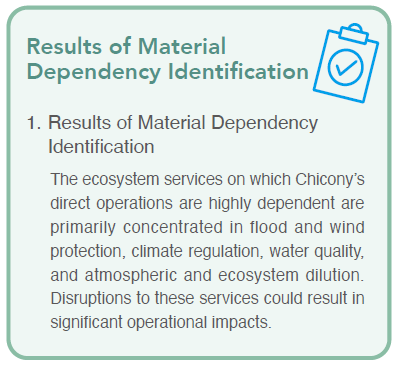
The outcomes of this phase provide a clearer definition of CEC’s interdependencies with natural resources and serve as a critical quantitative foundation for subsequent materiality assessments. By evaluating both the “likelihood of occurrence” and the “potential financial loss” associated with disruptions to ecosystem services, we developed a material dependency and impact matrix. This matrix helps identify our most significant nature-related dependencies and impacts, thereby enabling the prioritization of key risks and transition opportunities.
Results of Material Dependency Identification
Based on the identification results, we further assess the potential risks that may arise if the “natural capital” or “ecosystem services” on which our operations depend are disrupted, or if our business activities adversely impact ecosystems. At the same time, early identification and proactive management of these nature-related issues may enable us to create new business opportunities through technological innovation, enhanced resource efficiency, and the development of sustainable products and solutions.
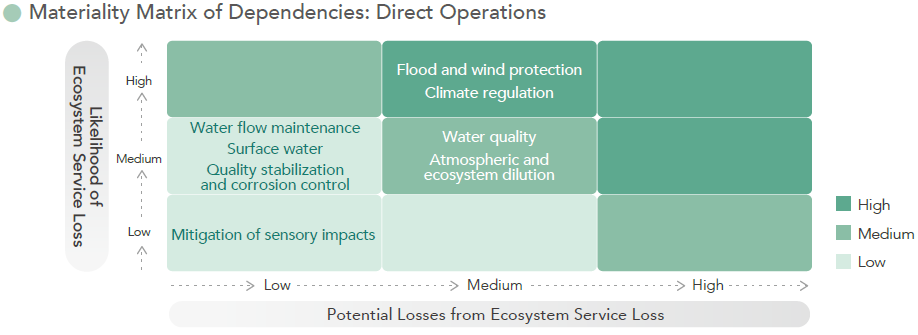
Description of Material Dependency Factors
| Ecosystem Services | Likelihood of Process Function Loss Due to Disruption of Ecosystem Services | Potential Consequences of Ecosystem Service Loss on Process Functions (Financial Impact) |
|---|---|---|
| Flood and Wind Protection | Environmental development surrounding Chicony’s direct operations may result in the loss or degradation of vegetation, thereby reducing soil water retention capacity. During severe storm events, exposed vegetation may further lead to soil erosion, adversely affecting direct operational activities. | The ecosystems surrounding Chicony’s direct operations are currently dominated by grassland or woody vegetation. Excessive development could lead to the loss of these ecosystem services, potentially undermining site foundations and further impacting production activities. |
| Atmospheric and Ecosystem Dilution | Air and water pollutant emissions from Chicony’s direct operations may reduce vegetation absorption capacity and affect water intake sources. Deterioration in water or air quality could further disrupt employees’ daily work and impair overall direct operations. | Although Chicony’s direct operations emit only limited air pollutants and most domestic wastewater is treated through local sewage treatment systems, the loss of relevant local ecosystem services could still adversely affect production operations and give rise to associated risks, including heightened regulatory oversight. |
| Surface Water | All direct operations require industrial water on an annual basis, primarily for domestic use and cooling tower operations. The occurrence of drought events could potentially disrupt direct operations. | As water consumption related to production at Chicony’s direct operations is relatively low and water recycling measures are implemented at all sites, such risks are assessed as unlikely to have a material impact on production operations. |
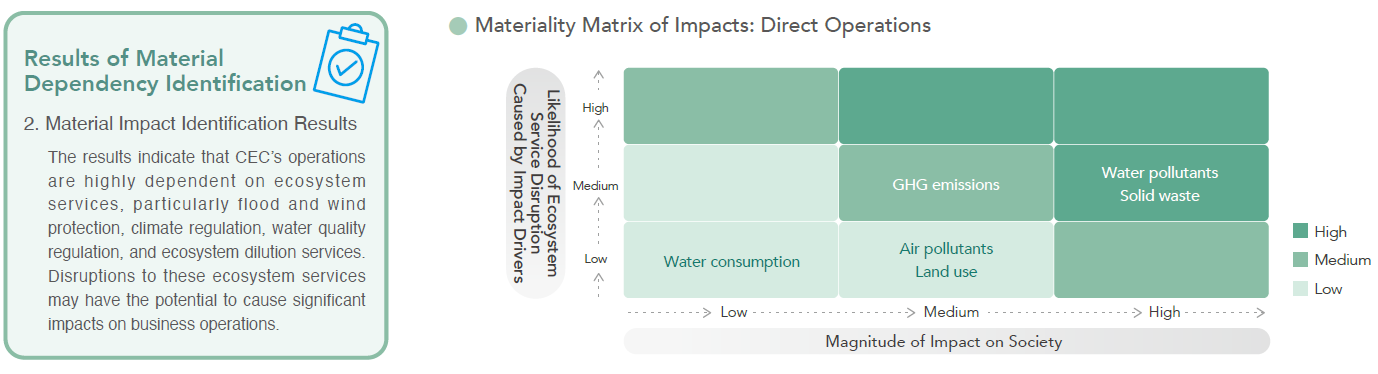
| Ecosystem Services | Natural Capital | Impact Driving Factors | Likelihood of Ecosystem Service Disruption Caused by Impact Drivers | Extent of Impact on Society from Ecosystem Service Loss |
|---|---|---|---|---|
| Flood and Wind Protection | Local Habitats | Land use; GHG emissions | Chicony’s direct operations do not involve large-scale land development in their local areas, and GHG emissions are relatively limited. Therefore, the level of impact on the local environment is not considered significant. | In low-lying areas, the loss of flood and wind protection could lead to potential regional economic impacts and adversely affect local communities and economic activities. |
| Surface Water | Water Resources | Water pollutants | Wastewater discharged from Chicony’s direct operations mainly consists of domestic wastewater. If discharged without proper treatment, it could lead to deterioration of local water quality. | Degradation of water quality could adversely affect water use by surrounding industries and hinder local communities’ access to and use of ecosystem services. |
| Solid waste | If solid waste is disposed of through landfilling and leachate is not properly treated, it may adversely affect the local water environment. | |||
| Atmospheric and Ecosystem Dilution | Atmosphere; Water Resources | Water pollutants; Air pollutants | Certain processes at Chicony’s direct operations may generate air pollutant emissions; however, emission volumes are not significant and have limited local impact. Impacts related to water pollutants are as described above. | If atmospheric and ecosystem dilution capacity were to be lost, some direct operations—particularly those located within industrial zones—may also be unable to benefit from this ecosystem service. |
Harnessing Nature for a Nature-Positive Transformation
At the end of 2023, CEC launched its Taskforce on Nature-related Financial Disclosures (TNFD) project. Over the following 18 months, we progressively implemented the TNFD-recommended “Locate,” “Evaluate,” “Assess,” and “Prepare” (LEAP) steps to identify nature-related risks and opportunities, assess potential scenarios and outcomes, and gradually integrate these assessment methodologies into our enterprise-wide risk management framework and processes.
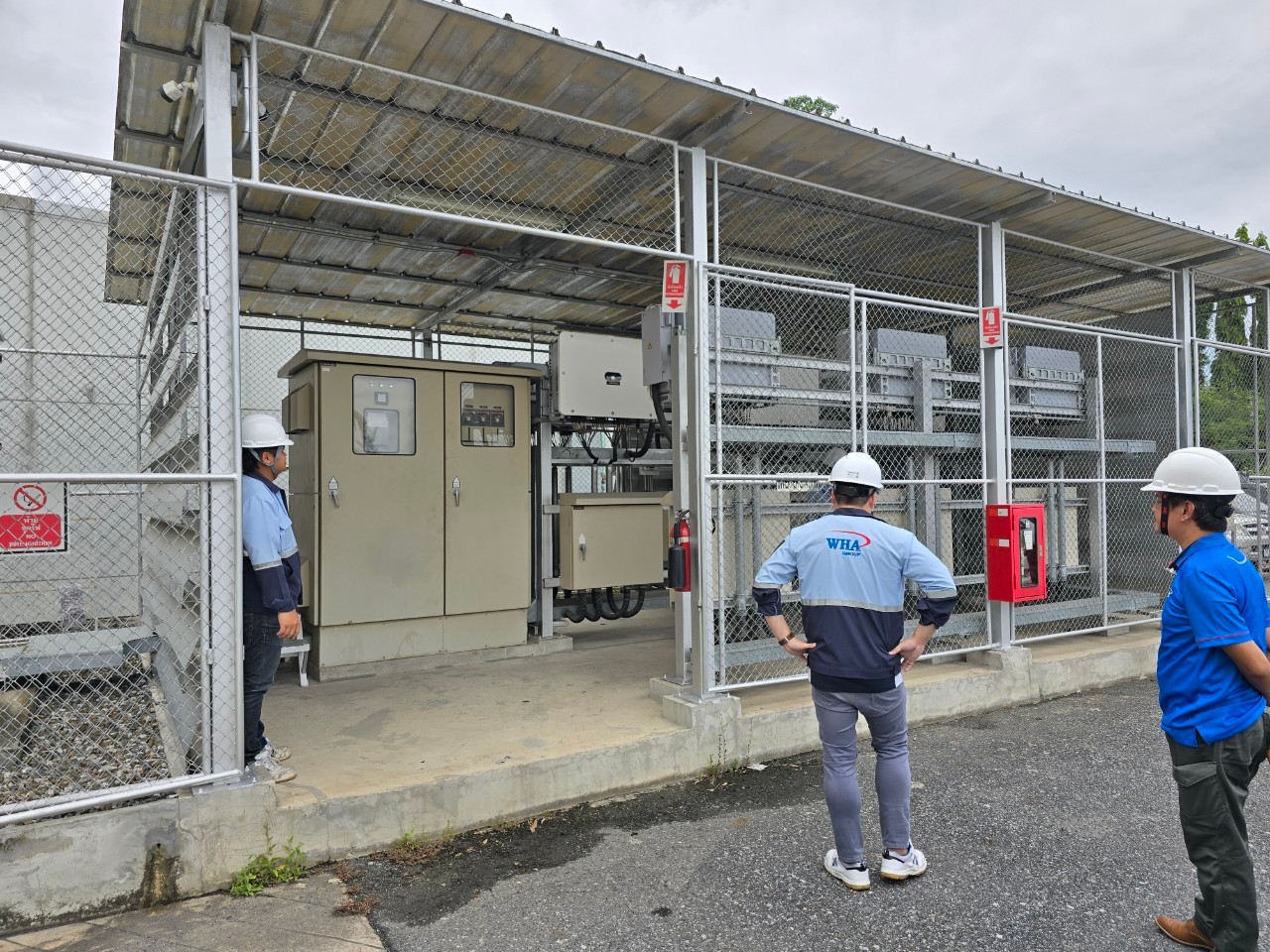
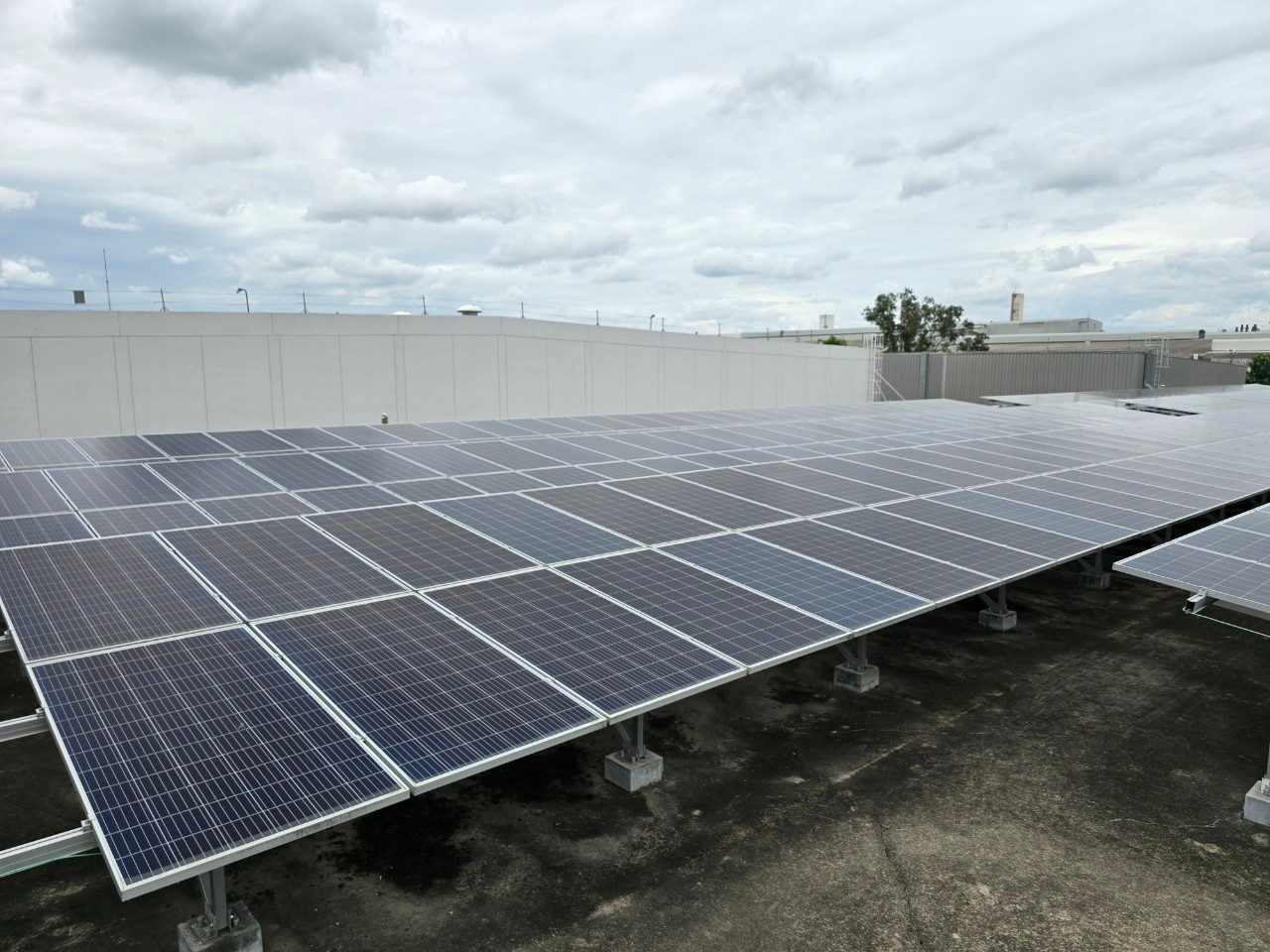
To continuously reduce our impacts on nature, we actively explore collaboration opportunities with value chain partners and stakeholders surrounding our operating sites. Through these efforts, we aim to progress toward our long-term goals of “No Net Loss” and “Net Positive Impact.”In 2024, we developed an Environmental and Social Due Diligence Checklist for renewable energy projects and, for the first time, distributed it to renewable power plants located near our Thailand manufacturing site. The assessment covers factors such as project type, whether the facility is located in biodiversity-sensitive areas, compliance with local regulations, and operation and maintenance practices.
Through this preliminary assessment, we seek to better understand whether the renewable electricity we procure is sourced from facilities with relatively lower impacts on the natural environment. In 2025, we expanded the assessment to renewable energy projects in China and continued to strengthen our due diligence practices across the value chain. These efforts demonstrate our commitment to responsible renewable energy procurement and nature-positive development.