Chicony Electronics fully recognizes the social and environmental responsibilities associated with the metals used in our products. In support of the Responsible Minerals Initiative (RMI), we are committed to "not procuring or using" minerals sourced from illegal mining activities, human rights violations, or the financing of armed conflicts. Our "Chicony Electronics Corporation Conflict Minerals Policy," signed and issued by the President, is implemented in accordance with the five-step framework outlined in the OECD "Due Diligence Guidance for Responsible Supply Chains of Minerals from Conflict-Affected and High-Risk Areas." We work closely with supply chain partners to establish a resilient and transparent responsible minerals management mechanism.
Each year, we requires raw material manufacturers and distributors to adopt the latest RMI reporting tools, including the “Conflict Minerals Reporting Template” (CMRT), the “Extended Minerals Reporting Template” (EMRT), and the “Additional Minerals Reporting Template” (AMRT), to conduct traceability investigations covering 3TG minerals (tantalum, tin, tungsten, and gold), as well as critical battery and electronic minerals such as cobalt, mica, nickel, and copper.
2025 Conflict Mineral Survey Results
| Report Category | Coverage | Results |
|---|---|---|
| CMRT | 634 Smelters |
271 gold smelters, 164 tin smelters, 102 tungsten smelters, and 97 tantalum smelters |
| EMRT | 196 Smelters |
145 cobalt smelters, 33 nickel smelters, 15 copper smelters, and 3 mica smelters |
| AMRT | 18 types of additional Minerals | aluminum, antimony, chromium, gallium, germanium, glass (silica), indium, iron, magnesium, palladium, platinum, rare earth elements, ruthenium, silicon, silver, steel, titanium, and zinc |
Based on the 2025 traceability assessment, after cross-checking and removing duplicate entries within the supply chain, a total of 31 smelters requiring improvement were identified. For these 31 smelters, Chicony fully initiated an enhanced due diligence and risk mitigation mechanism (Action Plan). As of the end of 2025, 21 had successfully completed corrective actions and replacement processes, while the remaining 10 continue to be subject to ongoing project tracking. The primary reason certain cases were not fully resolved within the reporting year was that, in response to customer requirements, Chicony implemented review standards more stringent than prevailing international norms. Although some smelters were not listed as non-conformant by the RMI, they nevertheless met the high-risk criteria defined by brand customers, prompting us to communicate with suppliers and require replacement within a specified timeframe. As these requirements exceed general industry practices, suppliers needed additional time for multi-tier communication and alternative material source validation, thereby extending the remediation timeline.
Upholding the principle of "continuous engagement and guidance," we have continued to closely monitor progress. As of February 2026, among the 10 smelters under ongoing tracking, 7 had successfully completed corrective actions and closed their cases. For the remaining 3 smelters, we have strictly required suppliers to establish clear final replacement timelines and have included these cases as key annual audit items. We will continue strengthening mineral traceability transparency through tiered management mechanisms and procurement contract requirements, thereby fulfilling our commitment to a sustainable supply chain.
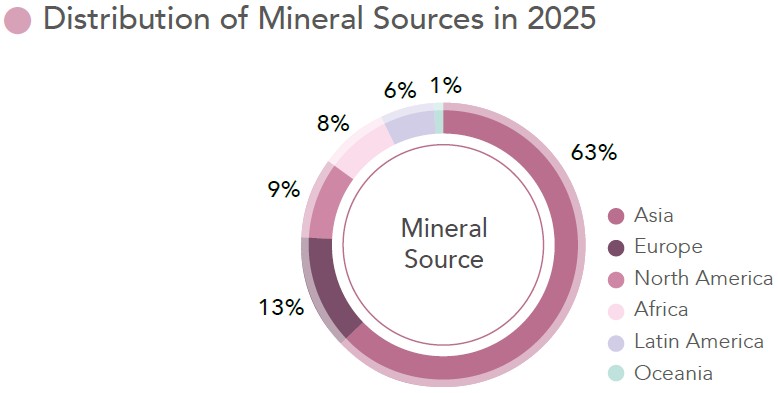
2025 Mineral Source Distribution