
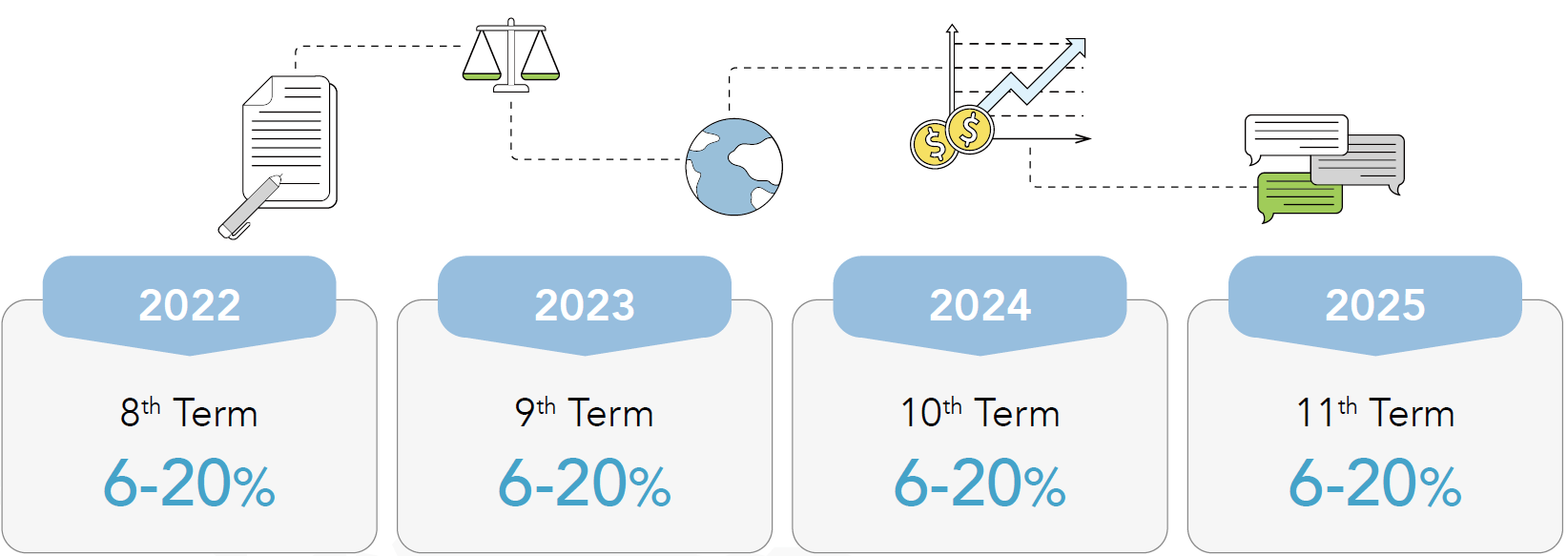
Historical Corporate Governance Evaluation Results
Chicony Electronics Corporate Governance Structure

Note:
1. Data as of March 31, 2026
2. For the scope of each department's responsibilities, please refer to the Company’s annual report.
Board Composition and Selection
Chicony's Board election system complies with legal requirements. In accordance with the Company's Articles of Incorporation, it adopts a candidate nomination system. Candidate qualifications are evaluated based on the Corporate Governance Best Practice Principles , considering core values, professional knowledge, and skills, to ensure the board possesses eight key competencies. Directors are elected at the shareholders' meeting in accordance with the Rules for Election of Directors, while also aligning with the Company’s Board Diversity Policy.
In 2025, the Company completed the reelection of its BOD. The 15th Board comprises a total of eight directors, including two female directors, representing 25% of the Board— an increase of one seat, or 12.5 percentage points, compared to the previous term. Directors aged 50 and above account for 100% of the Board. The board included one director with employee status (executive director), four nonexecutive directors without employee status, and three independent directors. The Chairman is a non-executive director who is not the same individual as the President, nor are they spouses or relatives within the first degree of kinship. (For further details, please refer to the Company's annual report.)
Functional Committee
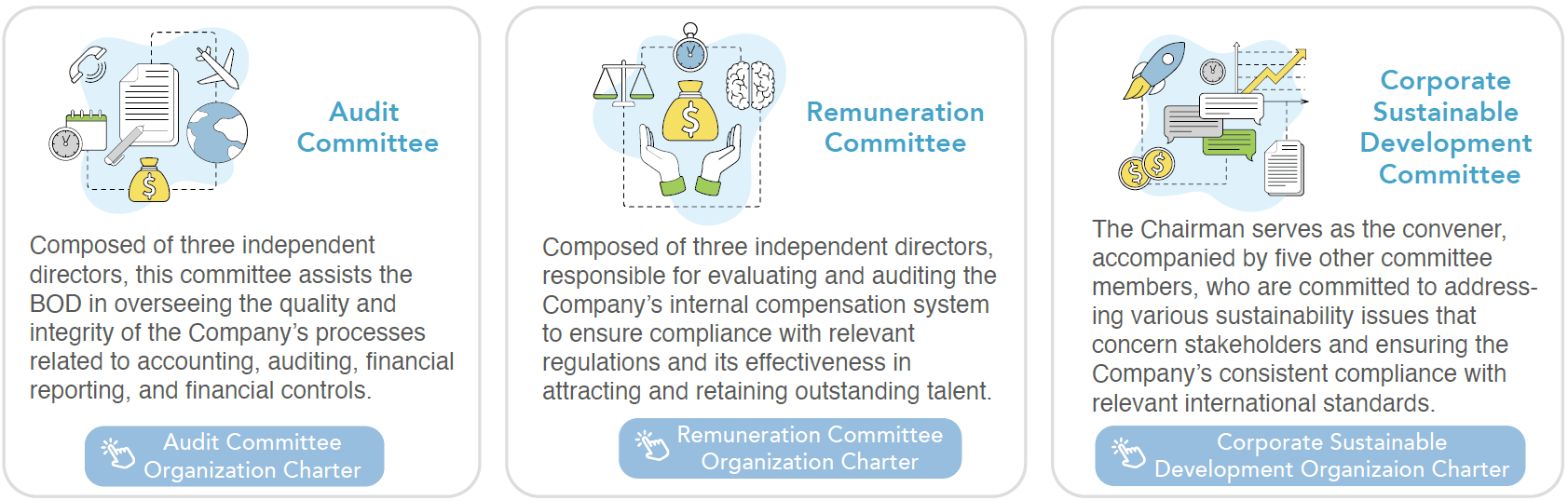
2025 Composition of the BOD and Functional Committees
| Board | Audit Committee | Remuneration Committee | Corporate Sustainable Development Committee | |
|---|---|---|---|---|
| Non-Executive Director | 4 | 0 | 0 | 1 |
| Executive Director | 1 | 0 | 0 | 1 |
| Independent Director | 3 | 3 | 3 | 3 |
|
Others |
0 | 0 | 0 |
1 |
Note: "Others" refers to the Company's Corporate Governance Officers.
| Board | Audit Committee | Remuneration Committee | Corporate Sustainable Development Committee | |
|---|---|---|---|---|
| Male | 6 | 2 | 2 | 4 |
| Female | 2 | 1 | 1 | 2 |
| Board | Audit Committee | Remuneration Committee | Corporate Sustainable Development Committee | |
|---|---|---|---|---|
| 51-60 | 1 | 1 | 1 | 2 |
| 61-70 | 5 | 2 | 2 | 4 |
| 71-75 | 2 | 0 | 0 | 0 |
2025 Attendance Rate of the 14th and 15th BOD and Functional Committees
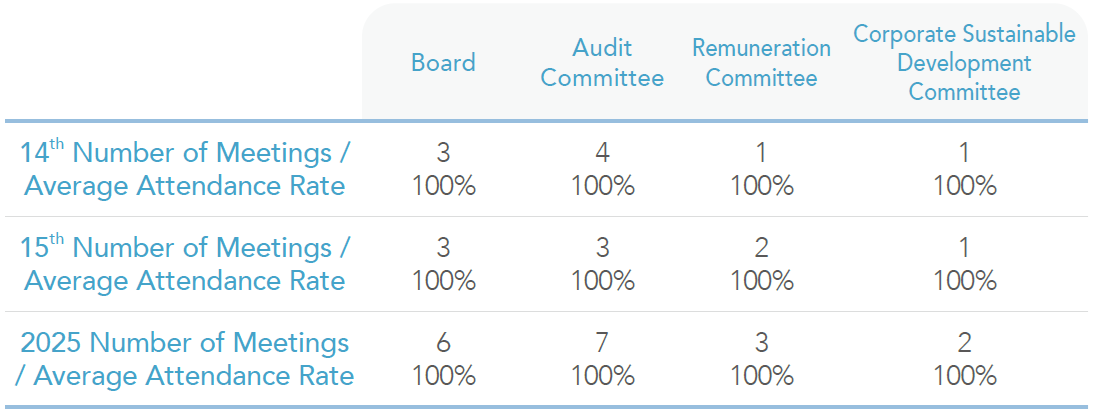
Operation of the BOD
In 2025, five board meetings were held, with an average attendance rate of 100% among directors. All voting proposals are governed by the "Board Meeting Rules of Procedure", which include provisions to avoid conflicts of interest. If a proposal pertains to the interests of a director or the corporation they represent, the director must disclose significant details of their interest during the board meeting. If the proposal may adversely affect the interests of the Company, the director must refrain from participating in the discussion and voting. Furthermore, they are prohibited from delegating their voting rights to other directors to ensure maximum benefit for stakeholders.
Continuing Education for the BOD
To ensure that the functions of the BOD align with the Company's development needs and respond to external trends, all directors enhance their overall knowledge annually through various professional development channels. In 2025, the total number of continuing education hours for all board members reached 48 hours, averaging 6 hours per member, thereby complying with the recommended standards established by regulations.
Board Performance Evaluation System
To assess the operational efficiency of the BOD, the Company has established the "Board Performance Evaluation Guidelines". Each year, evaluations are conducted for the BOD and various functional committees across five major dimensions, and for individual directors across six major dimensions. This includes an assessment of directors' performance concerning sustainability and climate risks, and we will continue to plan external performance evaluations. (For detailed assessment results, please refer to Chicony's Annual Report.)
Compensation Policy for Directors and Managers
The compensation policy for the Company’s directors and managers is grounded in corporate governance principles. In accordance with the “Remuneration Committee Charter”, the Remuneration Committee conducts quarterly reviews, considering the compensation levels of industry peers. This ensures that compensation accurately reflects the contributions of directors and managers to the Company, as well as the Company's performance, risk management, and achievement of its objectives. The results are submitted to the BOD for resolution and reported at the shareholders' meeting.
The Company’s pre-tax profit for the current period, after deducting employee and director compensation, shall allocate no less than 11% for employee compensation and no more than 1% for director compensation. In 2025, director and employee remuneration accounted for 0.73% of pre-tax profit.
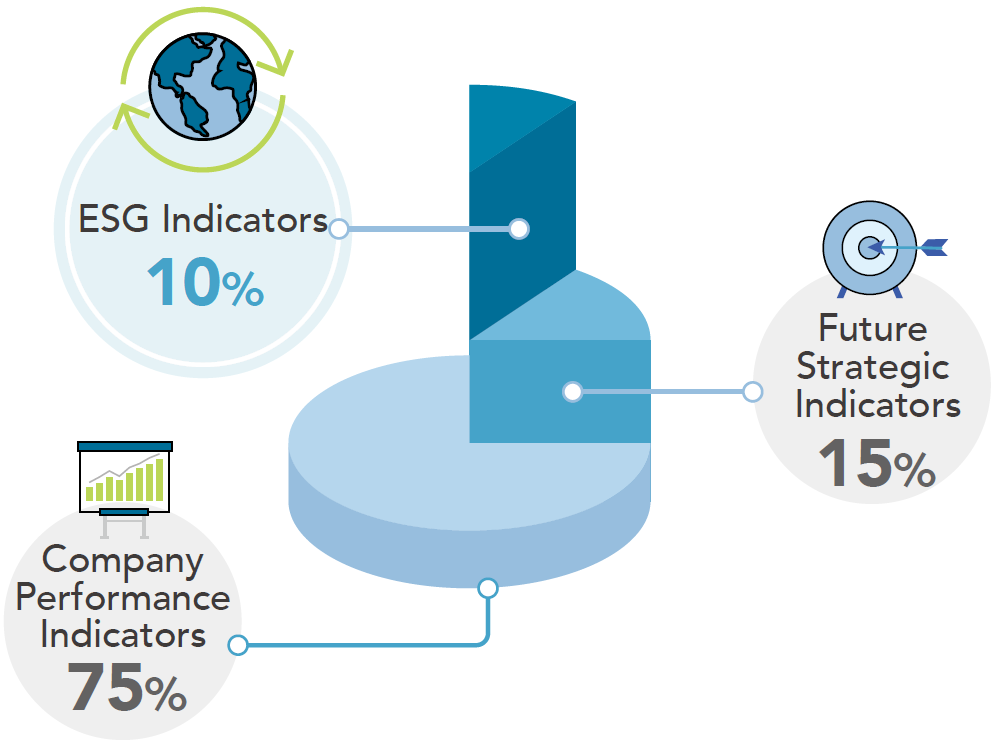
The salary structure of managers is highly correlated with both company performance and individual performance indicators. Compensation comprises fixed cash remuneration, variable stock options, and incentive measures such as profit-sharing and equity participation. Managers do not receive recruitment bonuses; however, employees below the level of department head are eligible for varying recruitment bonuses based on the circumstances surrounding their recommendations for new hires. If there are no violations of the law, there is no mechanism for recovering salary compensation. Retirement benefits for managers are the same as those for general employees. Since 2022, the Company has incorporated ESG indicators into the performance evaluations of directors, managers, and all employees to encourage active participation in advancing ESG initiatives.
Managerial Performance Evaluation Dimensions
Shareholder Equity
Chicony ensures that all shareholders are treated equally, with one share corresponding to one vote. We adopt a cumulative voting system favorable to minority shareholders. Each proposal is voted on individually, and the voting results are disclosed immediately. Shareholders may exercise their voting rights and participate in corporate decision-making through the shareholders’ meeting. Chicony has also established an Investor Relations Division to enhance communication with shareholders.

