Net Zero Emission Action Strategy
The Company obtained SBTi certification for its carbon reduction targets in 2022, and in 2023 committed to achieving RE100 by 2030 and net zero by 2050. Integrating these three commitments and referencing the SBTi methodology, we have planned a mid-term carbon reduction pathway under the 1.5°C GHG reduction scenario, selecting 2020 as the base year.
Chicony Net Zero Pathway
Unit: tCO2e
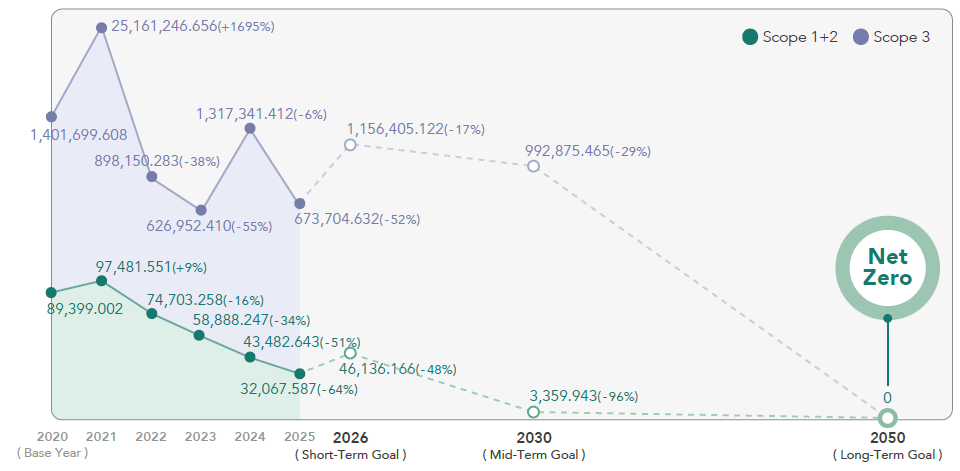
- The difference compared to the base year is indicated in parentheses.
- Scope of Data: HQ, Major Production Bases. Excluding subsidiaries Chicony Power and XAVI, and integrating the Company's SBTi, RE100, and net zero targets.
GHG Management Performance
In 2025, the inventory covered CEC’s Headquarters, domestic and overseas office locations, including Chicony Electronics CEZ s.r.o., Yangmei warehouse, Taichung office, Kaohsiung office, Chicony America Group Inc., and Chicony Electronics Japan, Inc., as well as all manufacturing sites, including CEM3, CEM2, CEM5, MR, and CET. The data scope covers 100% of Chicony’s consolidated financial reporting boundary.
A group-level verification approach was adopted to standardize inventory methodologies and verification procedures across all sites. CEC’s Scope 1 GHG emissions primarily arise from natural gas combustion in factory boilers, company vehicle use, and fugitive emissions from refrigerants. Scope 2 emissions are derived from purchased electricity. Considering the operational characteristics of each manufacturing site and industry requirements, CEC conducted inventory and verification for 10 Scope 3 categories, with emissions mainly from Purchased Goods and Services and Use of Sold Products. No biogenic emissions were identified within the inventory boundary.
GHG Emissions (Scope 1 Category)
Unit: tCO2e
|
|
CO2 |
CH4 |
N2O |
HFCs |
NF3 |
PFCs |
SF6 |
Total |
|
2024年 |
2,555.482 |
2,828.188 |
15.155 |
11.467 |
0 |
0 |
0 |
5,957.669 |
|
2025年 |
1,874.663 |
2,279.124 |
14.513 |
2,177.916 |
0 |
0 |
0 |
6,346.215 |
GHG Emissions (Scope 1 & 2)
Unit: tCO2e
|
|
2022 |
2023 |
2024 |
2025 |
|
Scope 1 (Cat.1) Direct GHG Emission |
7,555.208 |
6,827.888 |
5,957.669 |
6,346.215 |
|
Scope2 (Cat.2) Market Base Indirect emissions from the generation of purchased energy |
67,148.049 |
52,060.360 |
37,524.974 |
25,721.371 |
|
Scope2 (Cat.2) Location Base Indirect emissions from the generation of purchased energy |
N/A |
66,842.061 |
58,297.752 |
|
|
Scope1+2 Market Base |
74,703.258 |
58,888.247 |
43,482.643 |
32,067.587 |
|
Scope1+2 Location Base |
N/A |
72,799.730 |
64,112.990 |
|
|
Emission Intensity-Market Base |
1.09 |
1.00 |
0.70 |
0.53 |
Note:
- The statistical method employed is the operational control method, and the GWP value is based on the 2023 IPCC AR6 report.
- The source of the power coefficient is based on the publicly announced power emission coefficients from various locations. Other relevant coefficients are derived from local operators, government sources, and data published by the Intergovernmental Panel on Climate Change (IPCC).
- Scope of Data: All Production and Operation Bases. The subsidiary companies, Chicony Power and XAVI, can refer to the sustainability reports of the two subsidiaries for their data. The coverage of the disclosed data based on consolidated revenue calculations is 100%. The coverage rate of the verification is 100%.
- Emission intensity = total emissions ÷ consolidated revenue, unit: tCO2e/NT$ million.
Other indirect emissions (Scope3)
Unit: tCO2e
|
|
2022 |
2023 |
2024 |
2025 |
|
|
Category 3 Indirect GHG Emissions from Transportation |
Upstream Transportation and Distribution (4) |
9,541.072 |
10,617.751 |
13,915.497 |
7,610.257 |
|
Business Travel (6) |
190.408 |
603.027 |
980.305 |
1,541.421 |
|
|
Employee Commuting(7) |
2,605.204 |
1,420.538 |
2,247.233 |
2,905.883 |
|
|
Downstream Transportation and Distribution (9) |
22,441.985 |
11,001.680 |
17,108.972 |
32,275.317 |
|
|
Category 4 Indirect GHG Emissions from Products Used by Organization |
Purchased Goods and Services (1) |
449,068.360 |
283,407.128 |
1,005,689.865 |
239,596.663 |
|
Capital Goods (2) |
6,920.226 |
3,601.773 |
2,864.387 |
11,294.869 |
|
|
Fuel- and Energy-related Activities (3) |
6,397.792 |
5,775.200 |
11,983.628 |
5,869.123 |
|
|
Waste Generated in Operations (5) |
935.381 |
688.161 |
804.810 |
4,750.058 |
|
|
Upstream Leased Assets (8) |
1,111.309 |
955.604 |
822.485 |
823.064 |
|
|
Category 5 Indirect GHG Emissions Associated with the Use of Products from the Organization |
Use of Sold Products (11) |
389,194.337 |
299,245.820 |
255,154.305 |
361,128.030 |
|
Downstream Leased Assets (13) |
9,559.131 |
7,366.914 |
5,769.925 |
5,909.945 |
|
|
Total |
897,965.205 |
624,683.596 |
1,317,341.412 |
673,704.632 |
|
Note:
- The statistical method employed is the operational control method, and the GWP value is based on the 2023 IPCC AR6.
- 2022-2023 Scope of Data: HQ, Major Production Bases. The coverage of the disclosed data based on consolidated revenue calculations is 99%. The coverage rate of the verification is 99%.
- 2024-2025 Scope of Data: All Production and Operation Bases. The subsidiary companies, Chicony Power and XAVI, can refer to the sustainability reports of the two subsidiaries for their data. The coverage of the disclosed data based on consolidated revenue calculations is 100%. The coverage rate of the verification is 100%.
- The numbers in parentheses are categorized based on the Scope 3 evaluation tool of the GHG Protocol.
- Starting in 2025, categories 10 (processing of sold products) and 12 (end-of-life treatment of sold products) were excluded, as CEC is not a seller of end-user products and the materiality assessment did not meet the significance threshold.
- Starting in 2025, the raw material calculation methodology for designated manufacturing sites was refined from estimation-based calculations to actual production usage data. To maintain consistency, historical data will remain based on the original verified estimation methodology, while more accurate measured data will be used for future performance tracking. The base year will remain unchanged to preserve comparability.
ISO 14064 Carbon Management System
Carbon pricing
Energy Management Performance
2025 Energy Consumption
Unit: GJ
|
|
Taiwan |
CHINA |
Thailand |
Others |
Total |
Percentage |
|
Non-renewable Electricity |
11,920.86 |
104,903.10 |
47,709.31 |
703.85 |
165,237.12 |
36.6% |
|
Renewable Electricity |
- |
209,045.04 |
46,193.95 |
- |
255,238.99 |
56.5% |
|
Purchased Steam |
- |
- |
- |
906.83 |
906.83 |
0.2% |
|
Natural Gas |
- |
22,071.93 |
- |
- |
22,071.93 |
4.9% |
|
Gasoline |
416.50 |
3,724.85 |
- |
- |
4,142.49 |
0.9% |
|
Diesel |
38.95 |
3,431.38 |
862.88 |
106.47 |
4,457.76 |
1.0% |
|
Total Energy Consumption |
12,376.31 |
43,176.30 |
94,766.14 |
1,717.16 |
452,055.12 |
100.0% |
|
|
2022 |
2023 |
2024 |
2025 |
|
Total Electricity Consumption |
428,994.17 |
391,807.66 |
485,305.14 |
420,476.11 |
|
Purchased non-renewable Electricity |
370,883.47 |
222,821.34 |
271,856.66 |
165,237.12 |
|
Purchased Renewable Electricity (Certificates) |
57,923.36 |
164,190.58 |
201,371.71 |
231,477.60 |
|
Self-generated Renewable Energy |
187.34 |
4,795.74 |
12,076.77 |
23,761.39 |
|
Purchased Steam |
0 |
0 |
906.83 |
906.83 |
|
Liquefied Petroleum Gas (LPG) |
830.62 |
0 |
0 |
- |
|
Natural Gas |
36,038.18 |
32,031.49 |
38,915.69 |
22,071.93 |
|
Gasoline |
3,020.83 |
3,981.25 |
4,743.95 |
4,142.49 |
|
Diesel |
3,331.50 |
3,097.71 |
3,836.54 |
4,457.76 |
|
Total |
472,215.44 |
430,918.53 |
533,708.15 |
452,055.12 |
|
Energy Intensity(GJ/M NTD) |
6.88 |
7.29 |
8.64 |
7.32 |
Notes:
- 2022-2023 Scope of Data: HQ, Major Production Bases.
- Scope of Data After 2024: All Production and Operation Bases. Energy consumption outside of the organization was not calculated.
- The heating values were determined by referencing figures announced by the Bureau of Energy.
- Energy consumption intensity = Total energy consumption ÷ Consolidated revenue (Consolidated group revenue excluding revenues from CP and XAVI); Unit: GJ/NT$ million.
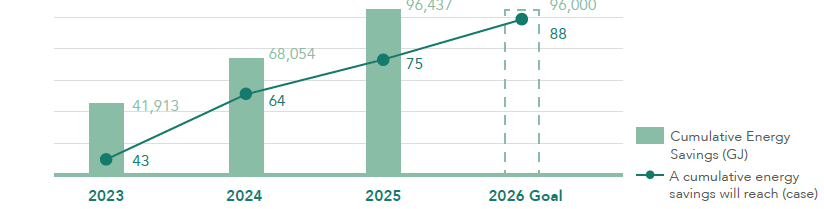
In 2025, we continued to improve energy efficiency through the optimization of energy management systems and equipment, achieving significant energy-saving results. A total of 11 energy management projects were implemented, generating energy savings of 28,383.31 GJ. The projects involved an investment of approximately NT$20,610.45 thousand, creating economic benefits of NT$18,832.53 thousand and reducing greenhouse gas emissions by 4,166.76 tCO₂e. Since the launch of the “Chicony Green Octagon” initiative in 2023, CEC has completed a total of 75 energy management projects, achieving cumulative energy savings of 96,437.41 GJ compared with the 2022 baseline year. Looking ahead, we aim to complete a cumulative total of 88 energy management projects by the end of 2026, with cumulative energy savings expected to reach 96,000 GJ.
Energy Conservation Projects
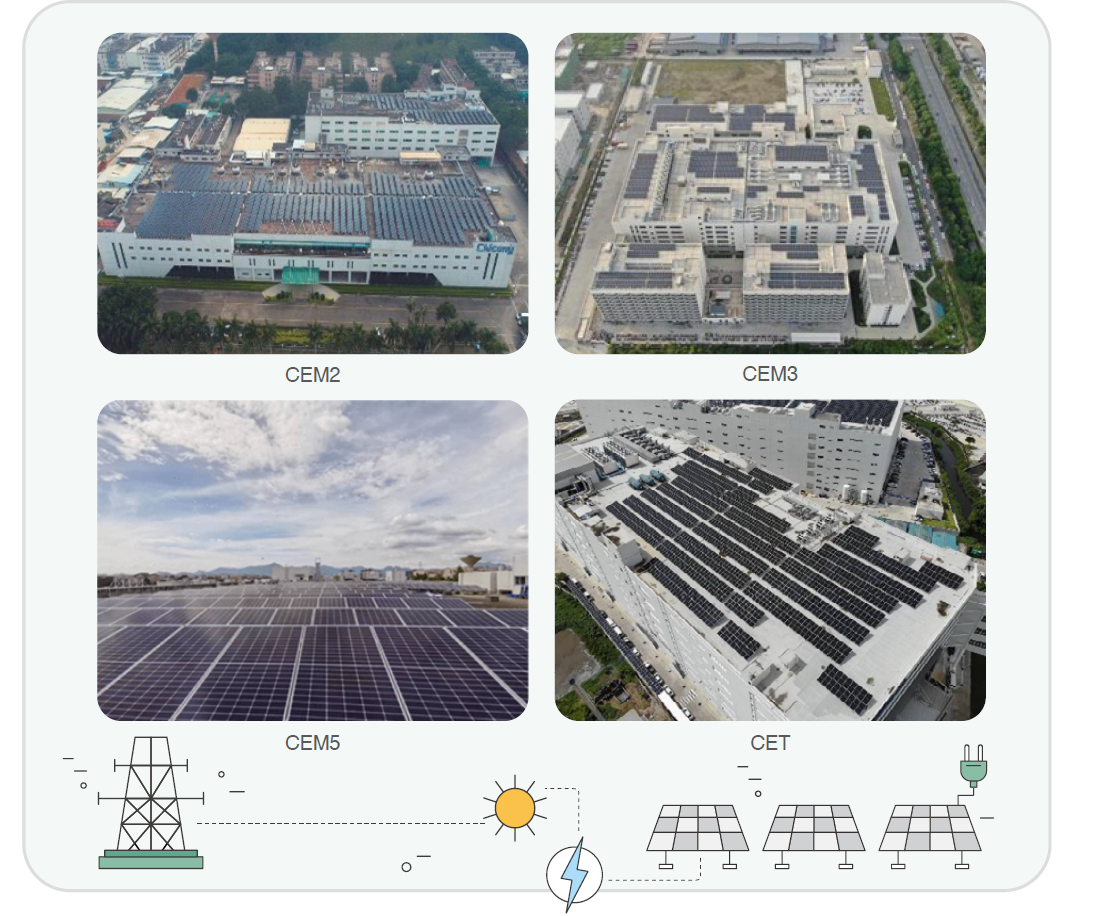
Energy Conservation Highlights Case Study of CEM2
- Annual energy savings:278.26 GJ
- Carbon reduction benefits:34.16 tCO2e
Energy Conservation Highlights Case Study of CEM3
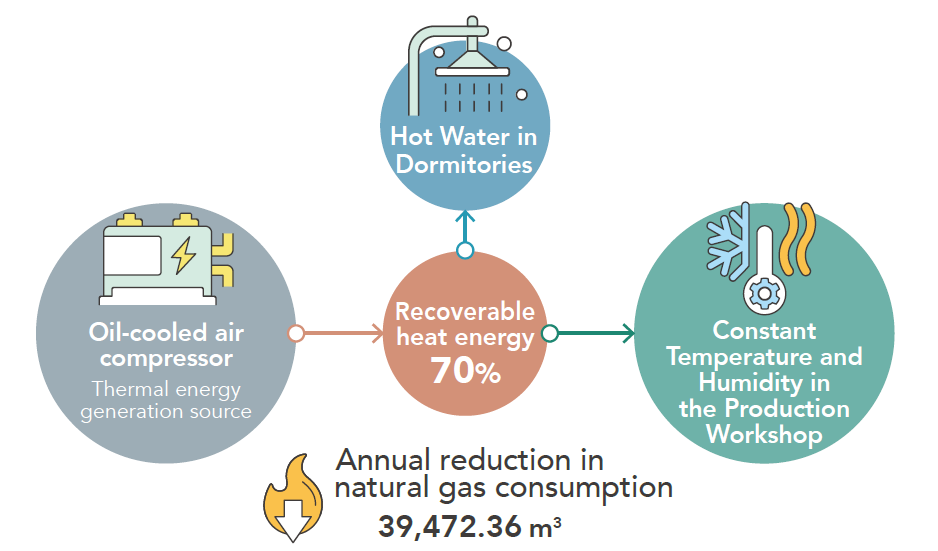
The centrifugal compressor and production lines adopted compressed air heatrecovery technology to reduce the demand of natural gas used for hot water inproduction areas and living quarters. A highlight of this project is the collaborationwith an ESCO under a performance-based contract, which reduced the initialinvestment cost by compensating the service provider based on the agreed energysavings.
- Annual energy savings:1329,90 GJ
- Carbon reduction benefits:74.75 tCO2e
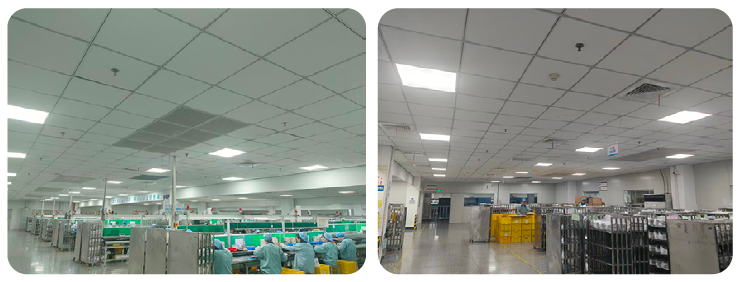
Energy Conservation Highlights Case Study of CEM5
- Annual energy savings: 778.79 GJ
- Carbon reduction benefits: 120.74 tCO2e
Electricity Usage and RE100 Progress
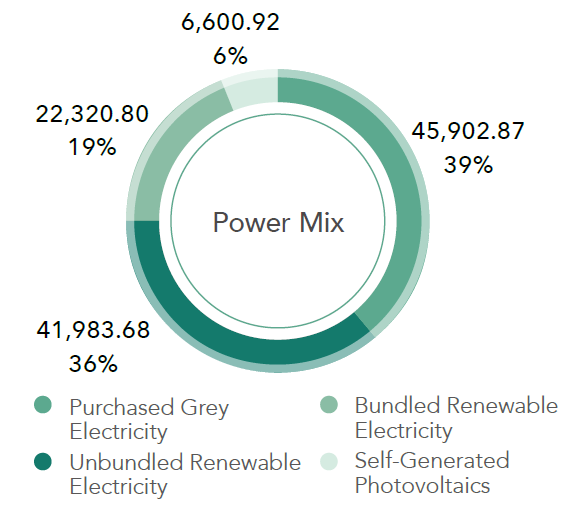
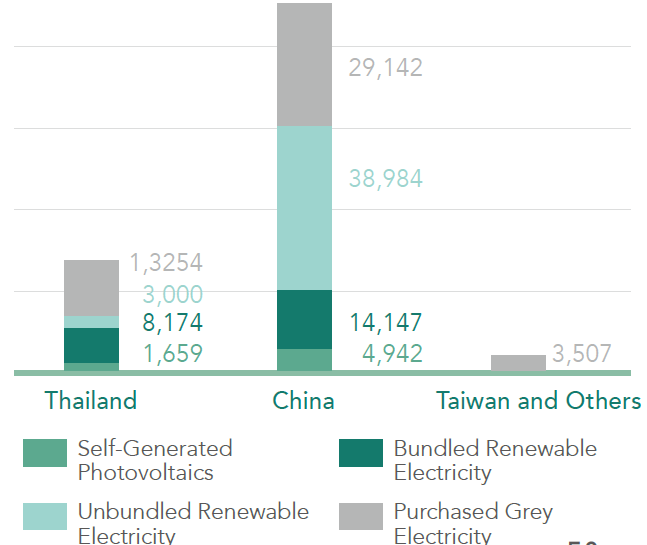
2025 Power Mix 2025 Distribution of Electricity Usage
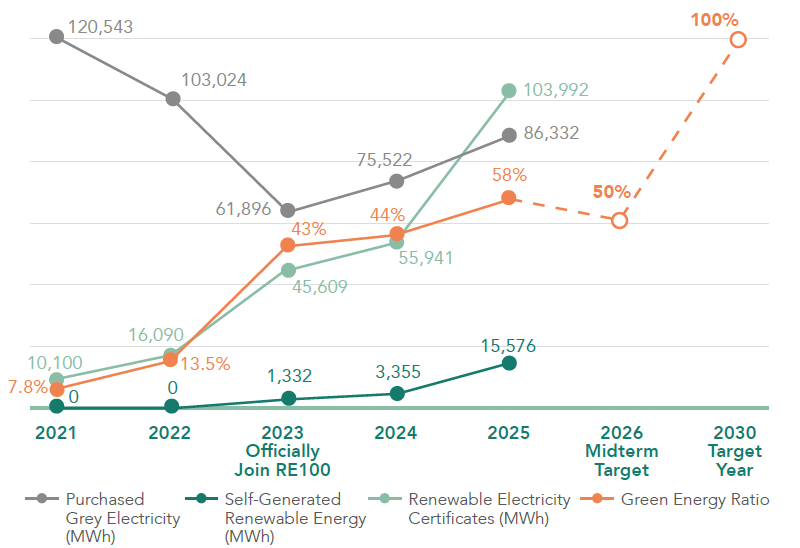
Chicony Group’s Renewable Electricity Consumption Roadmap
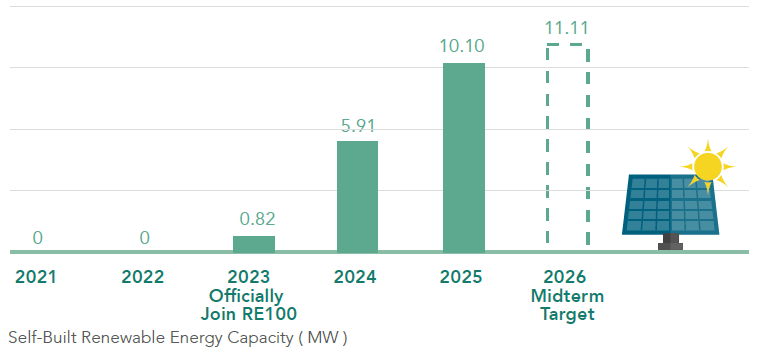
Self-Built Renewable Energy Capacity
Unit: MW